


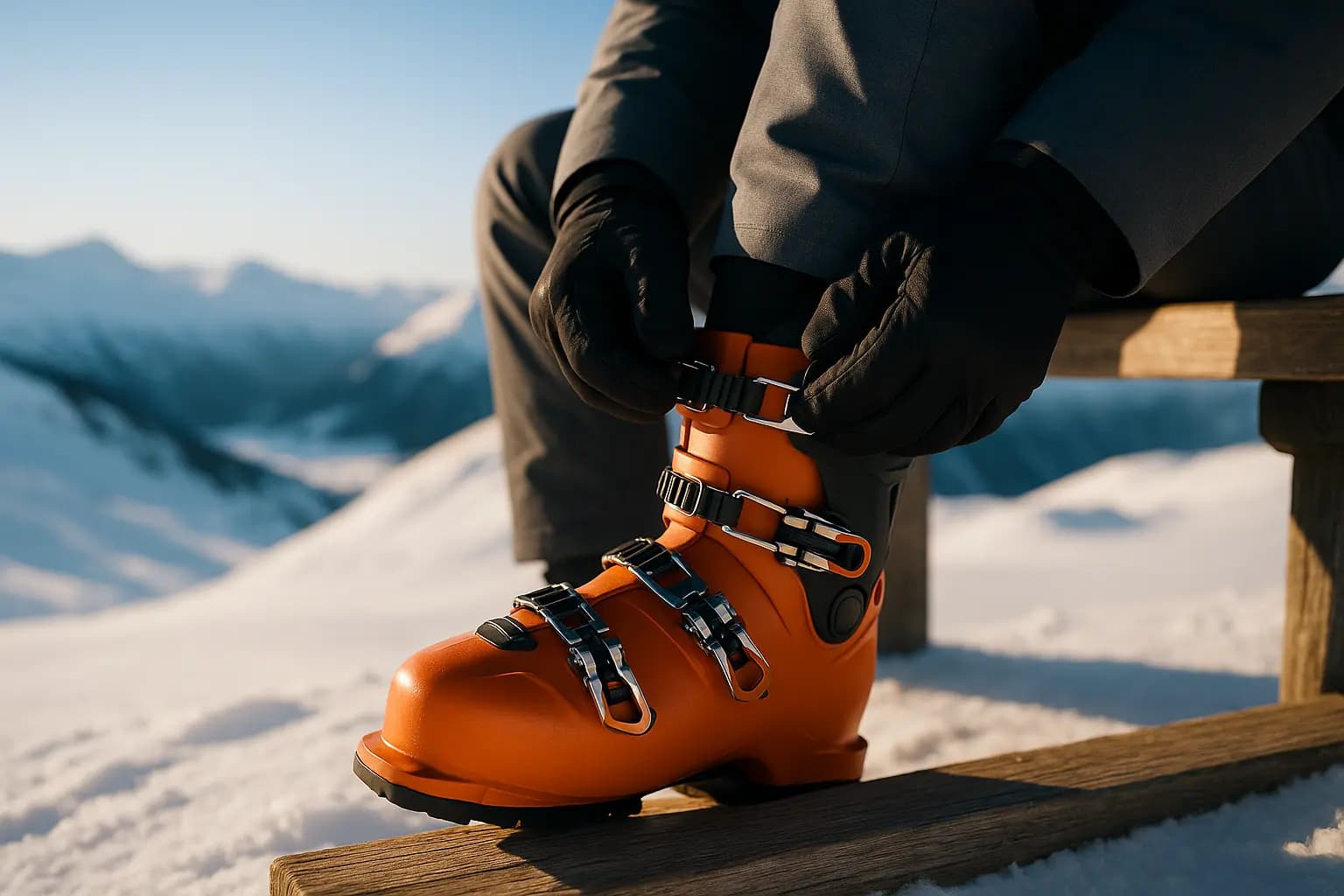
The ski boot is the key piece for combining fun and safety on the slopes. Three core criteria: the flex (stiffness matched to your level), the last (width for your foot shape), and your practice (piste, all-mountain, freeride, touring). Modern technologies such as the Boa® system and heat-moldable liners optimize comfort and precision.
Have you ever suffered through a run because of ill-fitting ski boots, turning your descent into a nightmare? The ski boot is often underrated, yet it's the key piece for combining fun and safety on the slopes. Discover the strategies to pick the perfect model, matched to your level, foot shape and practice, and finally avoid blisters or losing control. Thanks to core criteria such as flex, last and modern technologies — like the Boa® system for a precise closure or heat-moldable liners — boost your comfort, gain precision and unleash your full potential on the snow.
The ski boot: far more than a simple piece of gear
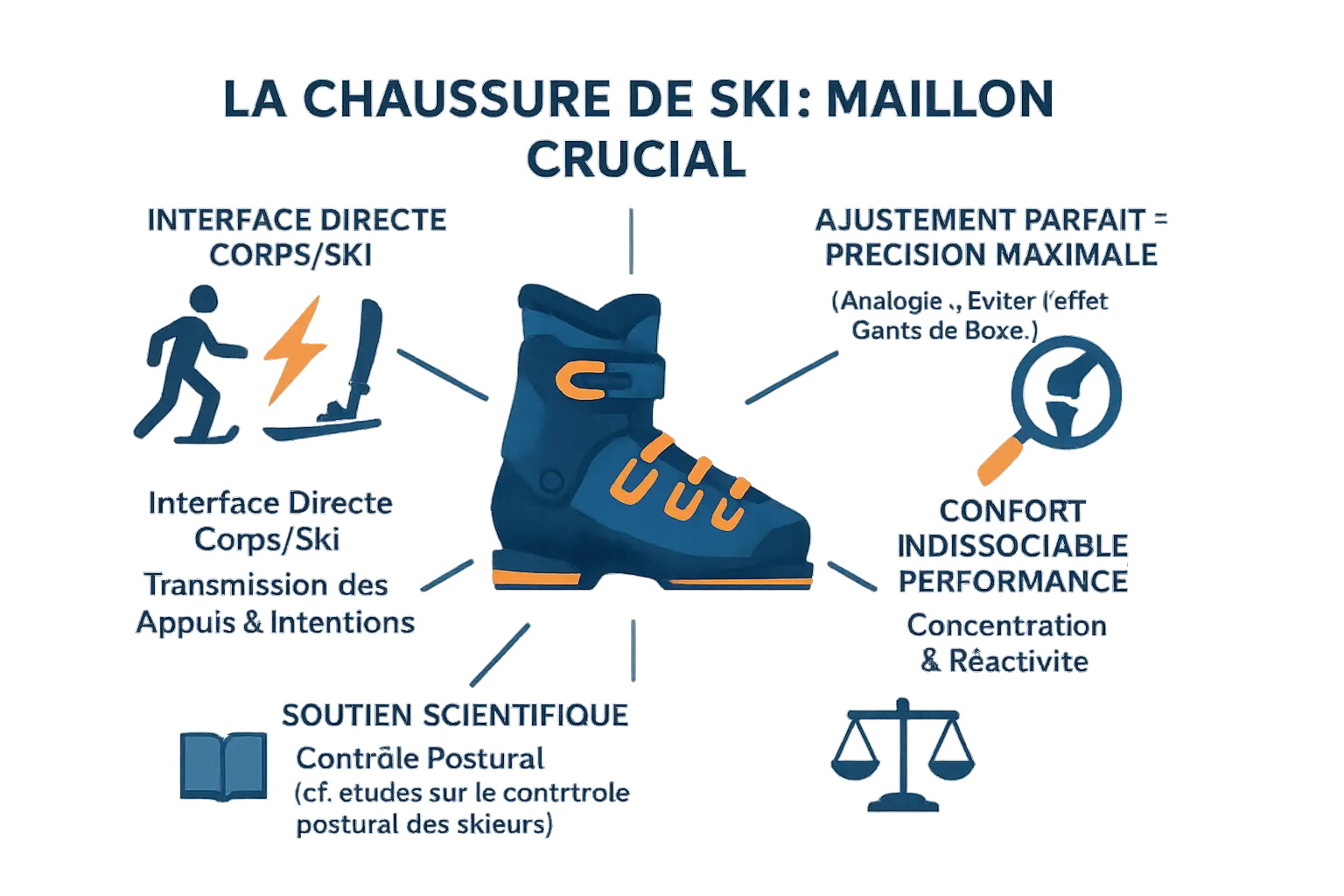
Choosing your ski boots is a major decision for every skier, whatever their level. The boot is the direct link between the skier's foot and the ski, playing a decisive role in transmitting weight shifts, turn intentions and changes of direction. Without it, even the highest-performing gear stays useless.
Picture driving a sports car wearing boxing gloves: that's the effect of an ill-fitting boot. Excessive or insufficient stiffness, poor fit or a lack of precise foot hold all dull your responsiveness. The boot must therefore combine stiffness and comfort to guarantee an instant response to your inputs.
Comfort isn't optional. A painful boot limits concentration, reduces responsiveness and can increase the risk of falls. This comes down to its impact on ankle proprioception — the ability to sense the position of the body. Studies, such as those on the postural control of skiers, show that stability depends on the precision of the fit.
The ski boot is the crucial link between your body and your skis. Without a perfect fit, even the best gear can't express its full potential.
Finally, the choice of boot becomes essential for striking a balance between performance and enjoyment. A model matched to your body type, skiing style and technical level lets you maximize control, conserve energy and make the most of the slopes. Trying boots on remains essential to avoid nasty surprises on the snow.
The 3 core criteria for choosing your ski boots
Your skiing level sets the stiffness: the flex
Flex is the stiffness index of a ski boot. It reflects the force needed to flex the ankle forward. A low value (60-90) suits beginners or lighter skiers, favoring comfort and forgiveness. A high value (110-140) is for experts, guaranteeing precision and responsiveness.
Women often find their sweet spot between 65-110, men between 95-140. A flex that's too stiff tires the calves, while a flex that's too soft limits control. Body type (weight, power) also influences the choice: a heavier skier needs a higher flex to transmit their force to the ski.
For example, an 80 kg expert skier on the piste will pick a flex 130 for an instant response. Conversely, an occasional skier will go for a more forgiving flex 80. Trying boots on remains the best way to confirm your choice, as sensations vary from brand to brand.
Your foot shape: the fit width (last) and the size
The last, or the width of the boot at the metatarsals, is measured in millimeters. A narrow foot (97-98 mm) needs a narrow fit to avoid pressure points. A wide foot (>102 mm) requires enough room to preserve blood flow and avoid cold feet.
Sizing follows the Mondopoint system, expressed in centimeters. A 27.5 cm foot corresponds to a Mondopoint 27.5 size. It's best to measure your bare foot, standing, with a foot-measuring gauge. A precise fit lets you hold the foot without crushing the toes.
For example, an intermediate female skier with a medium-width foot (102 mm) and a length of 26.5 Mondopoint will choose a 102 mm last boot. Heat-moldable liners adapt to unusual foot shapes, improving comfort. Trying boots on with ski socks is essential to confirm the fit.
Your main practice: piste, all-mountain, freeride or touring
Needs vary by terrain:
- Piste: Precision and responsiveness, with a high flex (110+) and a narrow last (98-100 mm) for experts.
- All-mountain: Versatility between on-piste and off-piste, with a medium flex (90-110) and a 100-102 mm last.
- Freeride: Cushioning and impact resistance, with a flex of 110-120 and a wide last (102-104 mm).
- Touring: Light weight and a walk mode, with a flex of 90-110 and a 100-102 mm last.
For trips into the mountains or outdoor leisure, some touring ski boots adapt to other activities.
| Skier level | Recommended flex (Men) | Recommended flex (Women) | Recommended last (foot width) |
|---|---|---|---|
| Beginner | 70-90 | 60-80 | 102-104 mm |
| Intermediate | 90-110 | 80-100 | 100-102 mm |
| Advanced / Expert | 110-140+ | 100-110+ | 98-100 mm |
These values are indicative. Trying boots on and getting expert advice remain paramount.
A boot matched to its use optimizes control and time spent skiing. Regular skiers check the condition of their gear often, because aging materials reduce stiffness. Cold temperatures make plastics stiffer, which is why trying boots on in real conditions is worthwhile when possible.
Decoding your boot: shell, liner and closure systems
The shell and the cuff: the boot's skeleton
The rigid shell, made of injected plastic (polyolefin), forms the structural base of the boot. Paired with the cuff, it wraps the foot and lower calf to transmit movements precisely to the ski. Its stiffness, defined by the flex index (60-80 for beginners, 90-100 for intermediates, 110+ for experts), influences responsiveness and comfort. An ill-matched flex tires the calves or reduces precision. The internal width (the "last") varies with foot shape: 97-100 mm for narrow to medium feet, 102 mm minimum for wide feet.
The liner: the heart of comfort
The heat-moldable liner adapts to the shape of the foot through controlled heating (an oven at 100°C). This process molds the materials to hug the unique contours of the foot, eliminating pressure points. Thermal insulation is reinforced by thick padding. Heat-molding, done in-store (€30-50), is recommended for an optimal fit. After the process, the liner keeps its shape for several seasons.
Buckles and closure technologies
An effective closure system ensures even hold. The key elements:
- The buckles: 2 to 4 of them, where quality beats quantity. Micro-adjustments target the critical zones (forefoot, ankle).
- The Power Strap: A wide strap reinforcing the shin's hold. Adjustable (ratchet or velcro system), it adapts to a demanding descent or a touring walk mode.
- The Boa® system: A patented mechanism with a metal cable and an H4+i1 dial. It delivers an even closure, cutting energy loss by 6%. It spreads the tension across the foot. Guaranteed for life, it suits demanding skiers.
Expert tip: Combining technologies (e.g. Boa® + Power Strap) maximizes control. A fine fit prevents rubbing and optimizes performance on every terrain.
The crucial question: how do I avoid foot pain?
My toes touch the end, is that normal?
When trying on a new ski boot, it's common to feel light contact between your toes and the end of the liner when standing upright. This comes from the flexing mechanism: when you lean forward (the typical ski stance), the heel slides back into the heel pocket, freeing up room for the toes. This simple test confirms the right size.
Light toe contact at the end of the boot when standing is normal. It's in the flexed position, knees forward, that the foot should slide back and feel held without being squeezed.
Watch for the signs of a wrong size: If your toes stay curled when you flex, the boot is too small. Conversely, if that space stays too large, it's probably too big. About 70% of skiers use boots that are too roomy, hurting their control.
To check the shell size, remove the liner, slide your bare foot in and measure the gap between heel and back. Between 1.5 and 2 cm is ideal. A thumb slipped behind the heel should fit without forcing.
Strategies and accessories for optimal comfort
To prevent pain, several concrete solutions are available to you. Here are the must-haves:
- Choose technical ski socks: Thin, seamless, and designed to wick moisture. Merino wool or synthetic models avoid pressure points and maintain the ideal temperature, unlike cotton.
- Use the right footbeds: A heat-molded or technical footbed supports the arch, stabilizes the foot and improves load distribution. It prevents sliding and repeated rubbing.
- Don't over-tighten the buckles: Excessive tightening, especially at the bottom of the boot, cuts off blood flow. The foot should be held, not strangled. Adjust gradually, standing in a stance close to your ski position.
- Call on a bootfitter: For specific cases, this professional adapts the shell or liner using techniques like "punching", solving pressure points.
The heat-moldable liner, once heated, adapts precisely to the foot's shape, while good use of technical footbeds can make up for half-size gaps. Finally, trying boots on with thin socks (silk type) and 15 to 20 minutes of use in-store lets you confirm the real fit, because the experience on the slopes often reveals details that go unnoticed standing still.
Men's, women's and kids' ski boots: specific needs
Women's boots: anatomical adaptations
Women's boots build in adjustments to compensate for anatomical differences. With a lower calf insertion and more fragile blood flow, models like the Rossignol Alltrack Pro 80 GW offer a flared cuff and a softer flex (around 80). The anatomical liner wraps the narrow heel while leaving room for a high instep, avoiding painful compression.
Men's boots: power and transmission
Male skiers benefit from boots like the Tecnica Mach Boa MV 130 GW, designed for a sturdier foot shape. With a high flex (130) and a 100 mm last, these models transfer force efficiently to the skis. The rigid structure paired with precise closure systems (such as Boa®) allows for optimal control on every terrain.
Kids' boots: flexibility and learning
For young skiers, the priority is flexibility and warmth. Models like the BOOT 100 Kids combine a low flex (60-90) and an adjustable footbed system to keep up with growth. A perfect fit avoids rubbing while allowing natural movements to learn in complete safety. Simplified closures encourage independence.
Rossignol Alltrack Pro 80 GW
Flared cuff and soft flex (80) for a female foot shape
Tecnica Mach Boa MV 130 GW
High flex (130) and Boa® system for maximum power
BOOT 100 Kids
Low flex (60-90) and adjustable footbed for growth
Caring for and retiring your ski boots
A well-maintained boot improves your performance and cuts costs. Here are the main tips to preserve their quality and build confidence in your gear.
- Drying: Remove the liner after each use to let it air-dry, away from intense heat sources like radiators. This avoids warping and odors caused by moisture.
- Shape: Close the buckles without tightening to hold the plastic shell in shape and guarantee an optimal fit every session.
- Footbeds: Check for wear regularly. Replace damaged footbeds to preserve safety with the bindings.
- Velcro: Clean the straps with adhesive tape or a wire brush. Clean velcro ensures effective hold.
At the end of their life, ski boots shouldn't go out with regular waste. According to ADEME:
- Give them to a charity or a friend if they still work.
- Drop them off at a specialist store for recycling through an approved body such as Ecologic.
- Bring them to a recycling center for energy recovery or material recycling.
In short, choosing your ski boots means balancing level (flex), foot shape (last) and practice (piste, freeride). A precise fit guarantees performance and safety. At specialist retailers, you can tap into the expertise of passionate staff, generous return policies and a selection tested by demanding skiers for descents in full confidence.
FAQ
What are the best ski boots for my ability level?
What are the best ski boots for my ability level?
The best ski boots depend on your ability level, your foot shape and your skiing style. Expert skiers will love the Salomon Shift Pro 130 AT (flex 130, last 100-106 mm) for its extreme precision and freeride-touring versatility, thanks to its Boa® closure system and heat-moldable liner. Advanced female skiers will favor the Rossignol Alltrack Pro 80 GW (flex 80), built for maximum comfort and a good balance of performance and light weight. For all-round use (piste and all-mountain), the Head Edge 110 HV GW (flex 110) delivers easy entry and excellent hold, with a 102 mm last suited to wider feet. Trying boots on in-store stays essential, as comfort varies from brand to brand.
How do I choose ski boots based on my level and foot shape?
How do I choose ski boots based on my level and foot shape?
For a smart choice, three criteria are essential: your level (a beginner should go for a soft flex of 70-90 for men, 60-80 for women, while an expert will favor a stiff flex of 110-140); your foot shape (narrow feet need a narrow last of 97-98 mm, wide feet a wide last of 102 mm and up); and your practice (the piste calls for a stiff boot for precision, while all-mountain or freeride need good cushioning and a walk mode for the approaches).
Is it normal for my toes to touch the end of ski boots when standing?
Is it normal for my toes to touch the end of ski boots when standing?
Yes, light toe contact at rest is normal and even desirable for a well-fitted boot. When you flex (knees forward), the heel slides back into the heel pocket, freeing up the forefoot. This mechanism confirms the right size. If your toes stay curled when you flex, the boot is too small. Conversely, no contact at all signals a boot that is too big, risking rubbing and a loss of control. A precise fit is crucial to keep your balance and avoid early fatigue.
Which boot models should I pick based on my level and skiing style?
Which boot models should I pick based on my level and skiing style?
For versatile use on and off the piste, go for an all-mountain boot like the Rossignol Alltrack Pro 100 MV (flex 100, last 100 mm), combining light weight and responsiveness. Freeride fans will appreciate the K2 Mindbender 110 Boa (flex 110), fitted with a walk mode and a light shell for powder days. For freeride touring, the Salomon Shift Supra Boa 95 (flex 95) offers a wide range of motion and a precise closure via the Boa® system. Finally, intermediate skiers will be well served by the Salomon S/Pro Delta 100 GW (flex 100), pairing comfort and power transmission thanks to its My CustomFit 4D liner.
Which ski boot brands combine comfort and performance?
Which ski boot brands combine comfort and performance?
The most comfortable models build in technologies such as heat-molding, the Boa® system and well-matched lasts. The Salomon S/Pro Delta 100 GW (flex 100) offers a heat-molded liner and a 102 mm width, ideal for generous feet. The K2 BFC 100 (flex 100) stands out with its 103 mm last and a Cushfit liner that avoids pressure points. Zufo boots are reinventing comfort with a modular exoskeleton, dropping the rigid shell while keeping smooth power transmission. Advanced female skiers will appreciate the Rossignol Track 70 W (flex 70), designed specifically for a female foot shape with a 104 mm last.
Is Salomon a reliable brand for ski boots?
Is Salomon a reliable brand for ski boots?
Yes, Salomon stands out as a benchmark thanks to its innovative technologies. The Shift Supra Boa 95 (flex 95) combines a walk mode and a precise closure for freeride-touring fans. The S/Pro Delta 100 GW (flex 100) delivers a custom fit via its My CustomFit 4D liner and a light chassis. These models build in the Coreframe system, boosting stiffness without adding weight. With a network of expert testers and innovations like Custom Shell HD, Salomon caters to demanding skiers, confirming its place among the must-have brands.
What solutions prevent foot pain in ski boots?
What solutions prevent foot pain in ski boots?
To avoid pain, several strategies are essential: favor thin, seamless technical socks made of merino wool for optimal thermal regulation; choose a heat-molded footbed that stabilizes the foot and spreads the load, reducing pressure on sensitive spots; avoid over-tightening, especially at the lower buckles, which cuts off blood flow; and turn to a bootfitter, a professional who can reshape the shell or adapt the liner to solve specific pressure points. These solutions, paired with a well-fitted boot, prevent discomfort and extend your enjoyment on the slopes.
How do I choose the right flex index for my ski level?
How do I choose the right flex index for my ski level?
The flex index, which measures the boot's stiffness, should be matched to your level and build: for beginners, flex 70-90 (men), 60-80 (women), as a soft flex makes learning easier by limiting muscle fatigue; for intermediates, flex 90-110 (men), 80-100 (women), a balance of forgiveness and responsiveness to progress on every terrain; for experts/advanced skiers, flex 110-140+ (men), 100-110+ (women), as added stiffness optimizes power transmission on piste or in freeride. Heavier skiers will favor a higher flex for better responsiveness, while lighter skiers can go for mid-range values. Trying boots on in-store stays essential, as sensations vary from brand to brand.


Loading...