


Prescription orthopedic shoes can be covered by health insurance when a specialist prescribes them. This pathway often gives you access to two pairs the first year to treat conditions such as the diabetic foot or severe bunions (hallux valgus). Be aware that online purchases are usually excluded from coverage.
Health insurance can cover a meaningful share of the cost of therapeutic footwear, yet the paperwork still trips up many patients. Finding prescription orthopedic shoes covered by insurance becomes a real challenge when you don't know the prescription rules and which models qualify.
This article breaks down the coverage conditions and the replacement schedule so you can get your equipment without a costly mistake.
Prescription orthopedic shoes: how coverage works overall
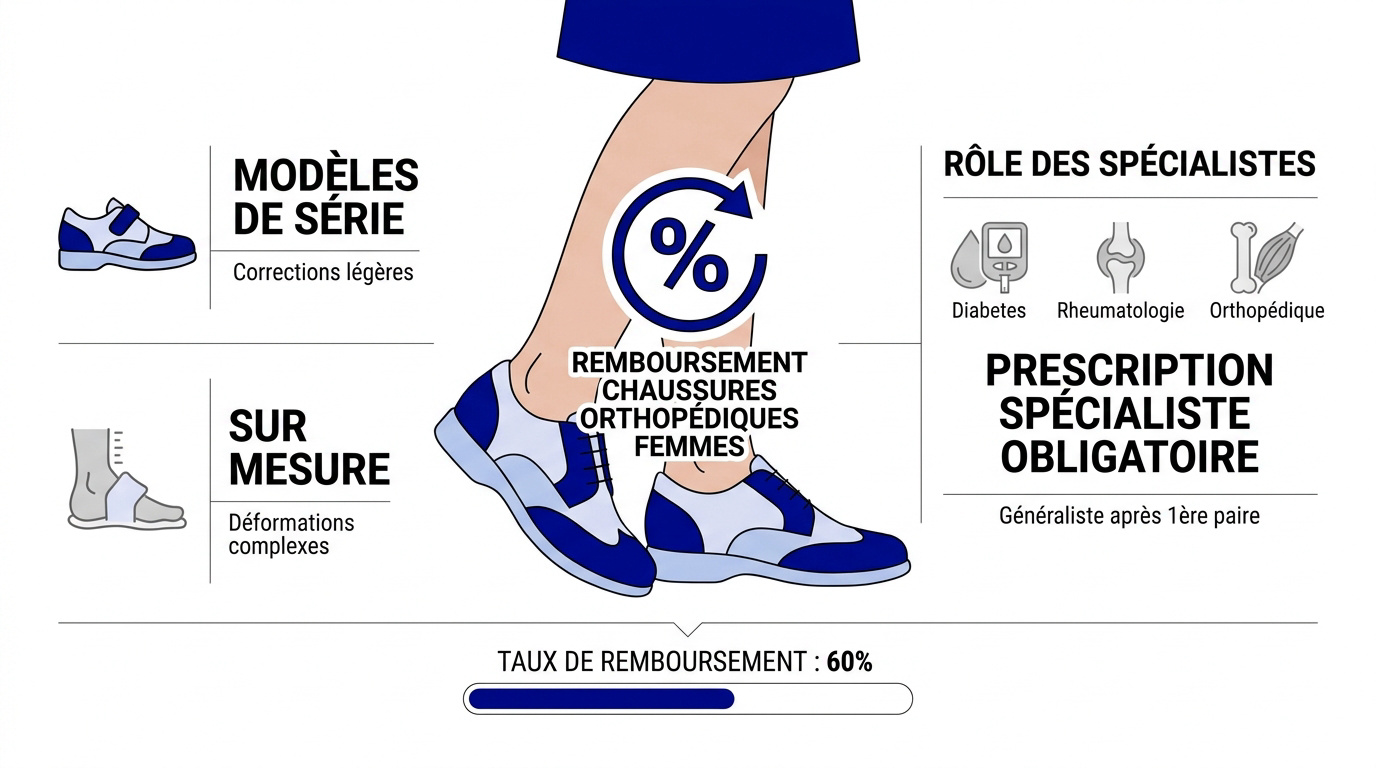
Health insurance can cover a set percentage of the approved base rate for orthopedic footwear once a specialist (endocrinologist, orthopedic surgeon) prescribes it. Getting two pairs the first year, then one pair a year afterward, depends on the distinction between off-the-shelf and custom-made models.
In practice, the choice of model depends directly on your specific condition.
Off-the-shelf models vs. custom-made footwear
Extended-use therapeutic shoes (off-the-shelf) correct mild permanent abnormalities. Custom-made models, by contrast, require a precise mold. They adapt to complex deformities, so each foot gets a unique structure.
The severity of your condition dictates your final choice. Off-the-shelf models often handle an increased foot volume. Custom-made shoes target the most serious conditions. They are an essential solution for significant deformities.
Read our complete guide to orthopedic shoe models for women to compare styles. These models combine medical comfort with a current look.
The role of specialists in the prescription
Only certain practitioners can write the initial order. Endocrinologists, rheumatologists and orthopedic surgeons are typically authorized. A general practitioner usually does not have that authority for a first pair.
The medical diagnosis confirms the need for the device. A clinical exam is a required step. Without that specialist assessment, insurers routinely deny any coverage.
The prescription has to be extremely precise. It details the type of shoes and the corrections required.
The renewal, however, changes things. A general practitioner can prescribe the following pairs after the first year.
3 conditions to validate your coverage claim
To get your claim approved, having a prescription isn't enough; following the administrative steps is crucial.

Required documents and the referral pathway
You need to provide the original medical prescription and your up-to-date proof of coverage. These documents are submitted by the pedorthist. Accurate paperwork keeps your claim moving smoothly.
Going through your primary care doctor before the specialist secures coverage at the full rate. Otherwise, financial penalties may apply to your reimbursement. Following the referral pathway is decisive.
Required documents for your claim:
- Prescription less than 6 months old
- Proof of health insurance coverage
- Up-to-date insurance card
Strict exclusion of online purchases
A certified provider has to fit the shoe to your foot. Online stores don't offer that essential technical service. An in-person fitting at a specialized store remains a non-negotiable condition.
Insurers require a paper or electronic claim form issued by a certified professional. The internet doesn't allow that traceability. Without that official document, no reimbursement is possible.
Read our articles on the world of orthopedics to understand the importance of expert advice in a specialized store. A professional will know how to guide you.
Major risk:
Choosing the wrong size without help from an expert pedorthist is a serious risk. The safety of your gait depends on it.
Which therapeutic shoes are actually covered?
Beyond the formalities, the nature of the shoe itself determines access to financial support.
Temporary use for short-term or post-operative conditions
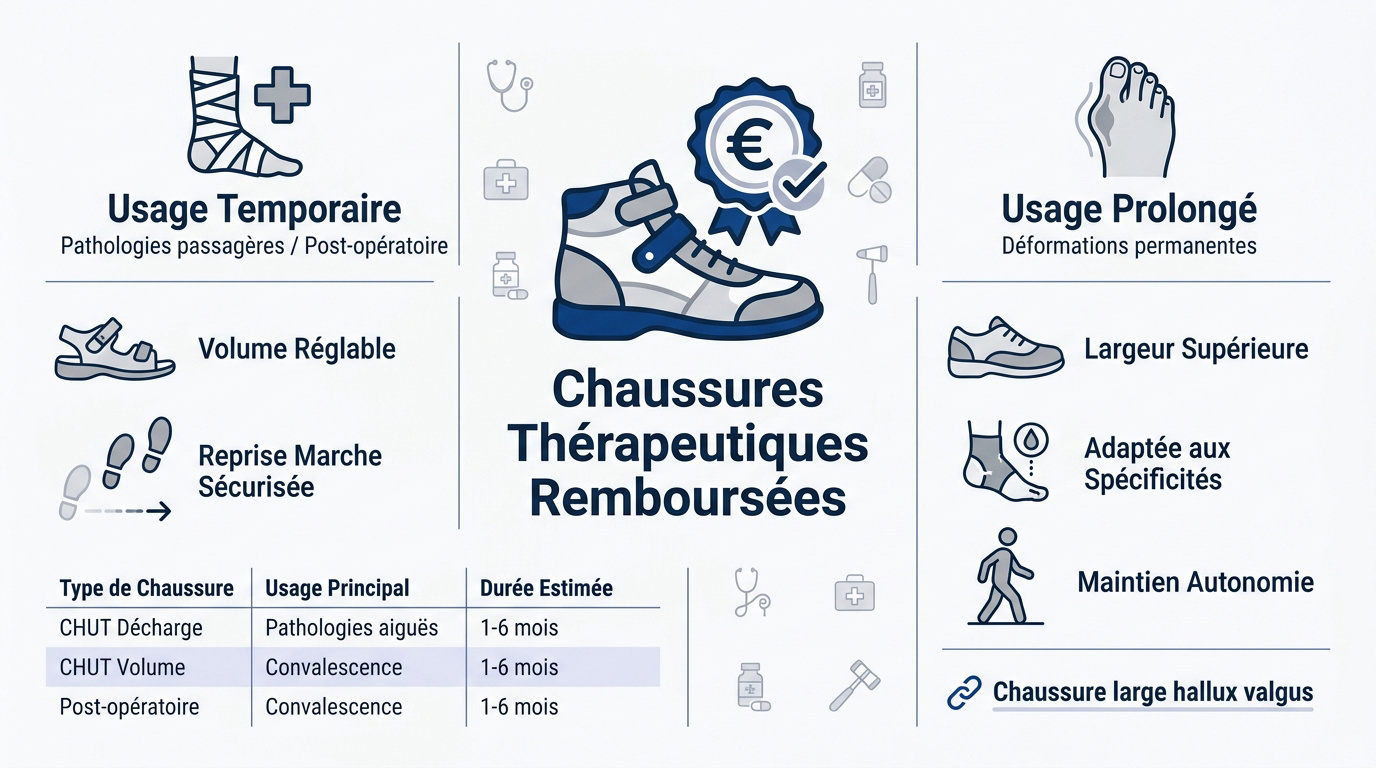
Temporary-use therapeutic shoes address short-term abnormalities. They are used for offloading after surgery or in cases of significant swelling. The volume is adjustable to fit a dressing. These models are essential medical devices.
They are often worn after forefoot surgery. They allow a safe, gradual return to walking. These shoes provide specific support. They keep weight off an injured area during the healing phase.
| Type of shoe | Main use | Estimated duration |
|---|---|---|
| Offloading shoe | Acute conditions / Wounds | 1 to 6 months |
| Volume-increase shoe | Inflammation / Swelling | 1 to 6 months |
| Post-operative shoe | Surgical recovery | 1 to 6 months |
Extended use for permanent foot deformities
Models for permanent abnormalities treat lasting conditions. These shoes address severe bunions (hallux valgus) or claw toes. They offer extra width to avoid painful friction. Comfort then becomes a daily medical priority.
Specific cases need special attention. Diabetic feet require seamless linings. Neurological conditions often call for reinforced ankle support. These devices prevent the worsening of skin or joint lesions.
You can read our guide to wide shoes for bunions for more detail. This choice is decisive for your comfort.
These models aim to preserve walking independence day to day despite the impairment. They ensure safe mobility over the long term.
Costs and timing to replace your equipment
Once you've chosen the model, you still need to understand the real cost and how often you can change pairs.
Coverage from health insurance and supplemental plans
Primary health insurance covers a set percentage of the approved base rate. A supplemental or secondary plan usually covers the rest depending on your contract. Be sure to check your orthopedics benefits.
Patients with a chronic, long-term condition can get 100% coverage. That avoids any large upfront payment at the provider. It's a major advantage for your budget.
In some cases, programs and assistance funds can offer additional help when resources are insufficient. Don't hesitate to ask about these complementary aids.
Legal frequency for replacing pairs
In the first prescription year, you are often entitled to two pairs. That gives you an immediate backup. It's a safeguard for your daily comfort.
After the first year, renewal is usually limited to one pair per year. Confirmed wear is required to justify the replacement. Your doctor then has to write a new prescription.
Coverage rules historically draw a distinction between adults and children, with children typically allowed more pairs because their feet grow.
Early replacement:
Early replacement is possible if a significant change in your condition occurs. A precise medical justification is then essential.
Enjoy lasting comfort with prescription orthopedic shoes covered by your health insurance. See a specialist for your initial prescription and visit a certified provider to validate your coverage. Get back to pain-free walking and preserved independence starting now.
FAQ
How do I get my prescription orthopedic shoes covered by insurance?
How do I get my prescription orthopedic shoes covered by insurance?
To qualify for coverage, you must first obtain a medical prescription. For a first pair, only a specialist (orthopedic surgeon, podiatrist, endocrinologist, rheumatologist, etc.) is typically authorized to write the original order. Health insurance usually reimburses a set percentage of the approved base rate for therapeutic footwear. The remaining share is often covered by a supplemental or secondary plan, except for a chronic, long-term condition where coverage can reach 100%.
Which types of therapeutic shoes are eligible for coverage?
Which types of therapeutic shoes are eligible for coverage?
Coverage applies to two main categories: off-the-shelf models and custom-made shoes. Temporary-use shoes handle post-operative phases or swelling, while extended-use models address permanent deformities such as severe bunions (hallux valgus). Custom-made orthopedic shoes are reserved for complex conditions that off-the-shelf models cannot fit. They are built from a precise mold of your foot to guarantee a perfect fit.
How often can I replace my orthopedic shoes?
How often can I replace my orthopedic shoes?
Many plans allow two pairs the first year so you can alternate immediately. Afterward, renewal is set at one pair per year for adults, counted from the previous purchase date. For children, the pace is faster, with two pairs per year typically covered. Early replacement remains possible when a sudden change in your condition or a significant morphological shift is medically documented.
Can I get reimbursed for orthopedic shoes bought online?
Can I get reimbursed for orthopedic shoes bought online?
Generally no. Therapeutic footwear is usually excluded from coverage when bought online. An in-person consultation and fitting by a certified provider are required to validate coverage. The pedorthist performs essential technical adjustments and issues a claim form. Online stores can't deliver that clinical follow-up and cannot issue the documents your claim needs.
Which doctors are authorized to prescribe orthopedic footwear?
Which doctors are authorized to prescribe orthopedic footwear?
The first prescription usually has to come from a specialist: an orthopedic surgeon, podiatrist, endocrinologist, rheumatologist or neurologist. A general practitioner often cannot write the first order. For every later renewal (from the second pair on), however, your primary care doctor is generally able to prescribe your new pair of orthopedic shoes.


Loading...